Working on DustBox2: Taking the Original Idea Further
By Gee Dark – Darkstarz Technologies
Over the last several months, I’ve been spending a lot of time working on a new plugin called DustBox2.
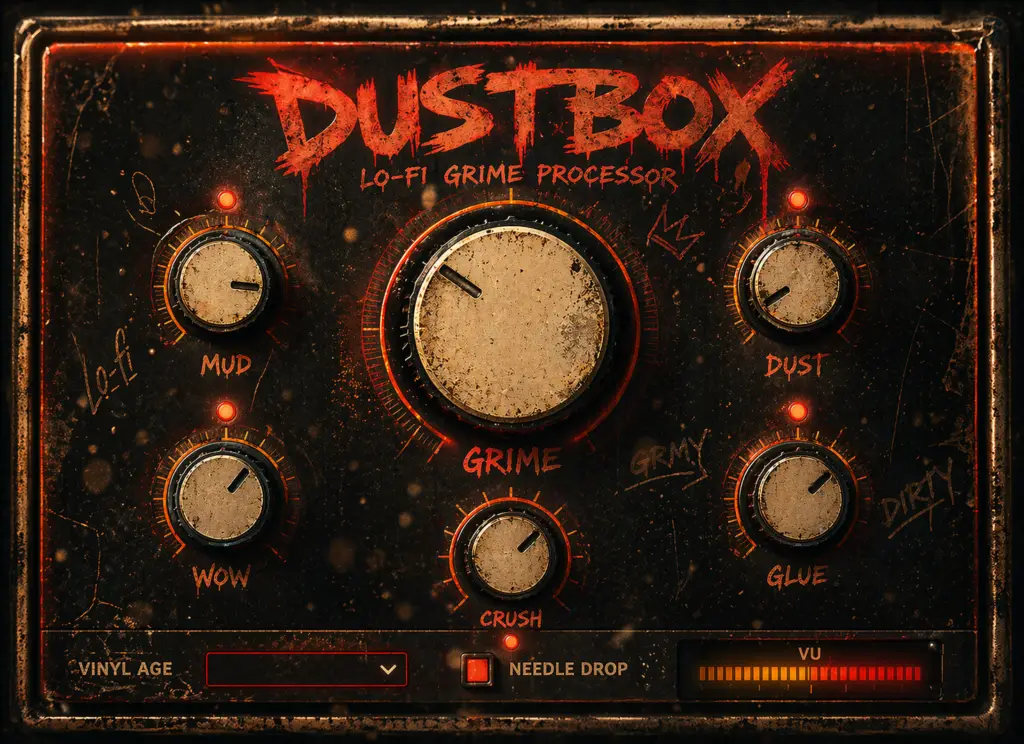
For those who have followed Darkstarz Technologies from the beginning, you may remember the original DustBox concept.
DustBox started as a simple idea.
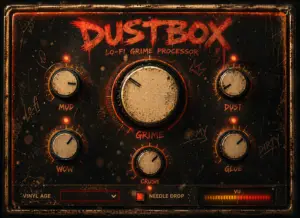
I wanted a straightforward tool that could quickly add grit, dirt, warmth, and character to sounds without having to stack multiple plugins together. As a producer, I’ve always been drawn to imperfections—the crackle of old vinyl, the movement of worn cassette tapes, the punch of vintage samplers, and the raw energy found on underground hip hop records.
The original DustBox was built around that mindset.
As I continued producing music and testing different workflows, I started collecting ideas that didn’t fit into the original concept. I wanted more control. I wanted better tape processing. I wanted textures that felt organic. I wanted a plugin that could move beyond basic lo-fi effects while still remaining simple and inspiring to use. I hand drawed the ui and used Photoshop to make it a reality. I handcrafted the gui and used photoshop to color and make it usable But everyone thinks its Ai lol. With DustBox2 I used a mix of my drawing and gui techniques and it worked.
That’s where DustBox2 comes in.
Rather than replacing the original idea, DustBox2 expands on it.
Many of the things that made DustBox appealing are still here. The difference is that DustBox2 gives producers more ways to shape those sounds and push them further.
Why DustBox2?
One thing I’ve noticed over the years is that many modern productions sound extremely clean.
There’s nothing wrong with that.
But sometimes clean can become sterile.
Some of my favorite records have imperfections that give them personality. Slight saturation. Tape wear. Vinyl noise. Sampler grit. Small flaws that make the music feel human.
DustBox2 is being built around the idea of bringing some of that character back into digital production.
The goal isn’t necessarily to make things sound old.
The goal is to make things sound interesting.
Developing the Filth Engine
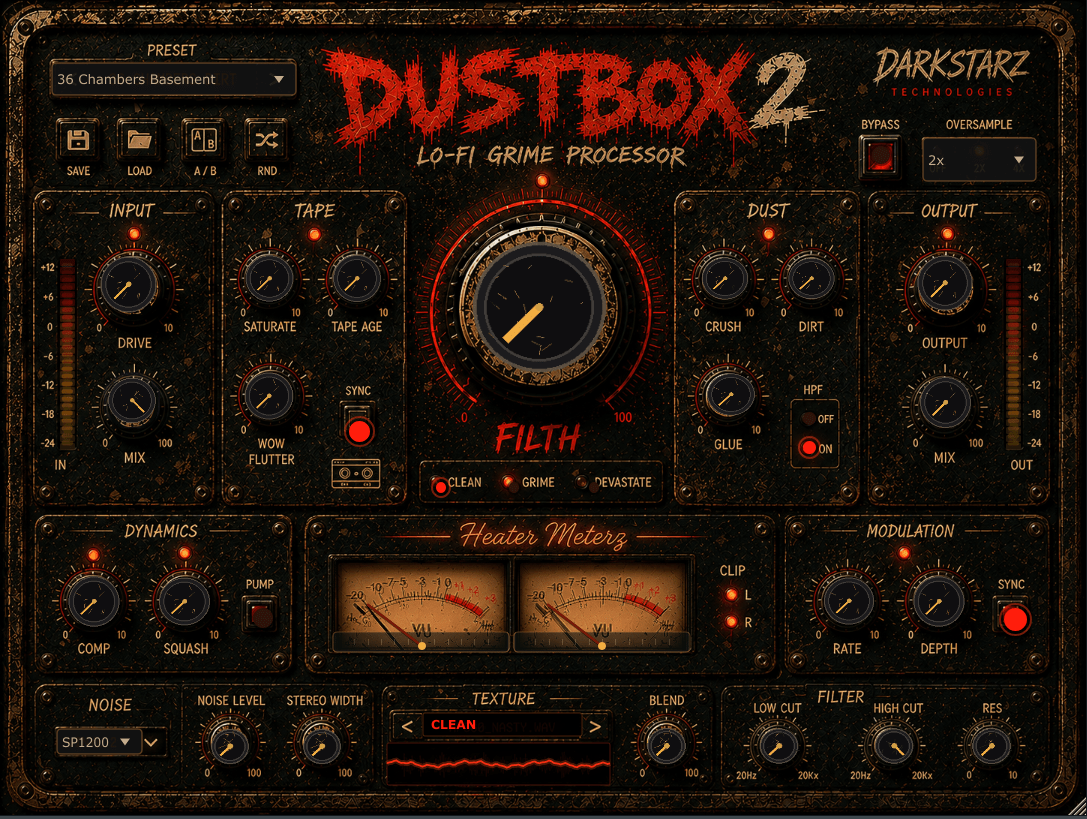
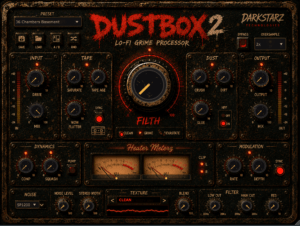
One of the biggest features currently being developed is the Filth control.
Instead of forcing producers to adjust a dozen different parameters just to find a vibe, I wanted a control that could immediately change the personality of a sound.
Behind the scenes, the Filth engine combines various forms of saturation, coloration, degradation, and texture processing.
At lower settings it can add subtle warmth and weight.
Push it harder and it can completely transform a sound into something dirty, aggressive, and unpredictable.
It’s still being refined, but it has quickly become one of my favorite parts of the plugin.
Expanding the Tape Section
Tape has always fascinated me because it adds movement to audio.
Not everything stays perfectly stable.
Pitch drifts.
High frequencies soften.
Textures develop over time.
DustBox2 includes a dedicated tape section that allows users to introduce some of those characteristics into their productions.
Current controls include:
- Saturation
- Tape Age
- Wow
- Flutter
- Sync Functions
The goal isn’t to recreate a specific machine.
It’s to capture the feeling that tape brings to a recording.
The Texture Engine
One area that has evolved significantly during development is the Texture Engine.
Most plugins simply add noise.
I wanted to go a little deeper than that.
The textures being developed for DustBox2 are designed to influence the overall mood and character of a sound rather than simply layering noise on top.
Some of the texture concepts currently being explored include:
- Dusty
- Vinyl
- Basement
- VHS
- Tape Machine
- Radio Broadcast
- Broken Speaker
- Analog Decay
These textures can be subtle or dramatic depending on how they’re used.
Building Better Presets
I’ve also spent a surprising amount of time working on presets.
Most producers know the experience of opening a plugin and scrolling through hundreds of presets that all sound nearly identical.
That’s something I wanted to avoid.
The DustBox2 presets are being created from actual production sessions.
Whenever I build a setting that I find myself returning to repeatedly while making beats, it gets saved, refined, and tested as a potential factory preset.
Some of the preset concepts currently being developed include:
36 Chambers Basement
A dark and gritty preset inspired by underground recording environments.
Boom Bap Smoke
Designed for dusty drums, chopped samples, and classic hip hop production.
Cassette Crime Scene
Heavy tape wear, movement, and nostalgic degradation.
Street Corner Radio
Inspired by music blasting through worn-out speakers outside a neighborhood bodega.
Midnight Transit
Dark textures and atmosphere influenced by late-night subway rides.
Burnt Circuits
Aggressive degradation and digital destruction.
Forgotten Demo Tape
A preset designed to sound like an old cassette recording discovered years later.
The goal is for every preset to provide either a useful starting point or immediate inspiration.
Noise With Purpose
Of course, no plugin called DustBox2 would be complete without noise.
But I wanted the noise section to be more than just vinyl crackle.
Current concepts include:
- Vinyl Noise
- Tape Hiss
- Radio Static
- Electrical Hum
- Mechanical Noise
- Sampler Noise
- Room Ambience
Used carefully, these sounds can help a track feel more alive and less sterile.
The User Interface
The visual design has evolved alongside the audio engine.
I wanted DustBox2 to feel like a piece of forgotten hardware. Something you might discover in an old studio tucked away in a basement after years of making records.
The current interface features aged textures, analog-inspired meters, industrial styling, and a workflow focused on getting results quickly.
One area I’ve spent a surprising amount of time on is the controls themselves.
Rather than relying on generic plugin graphics, I’ve been creating custom animated knobs and interface elements specifically for DustBox2. Many of the controls feature subtle animation and floating dust particle effects that move as parameters are adjusted, helping reinforce the plugin’s overall theme of age, grit, and character.
It’s a small detail that many users may never consciously notice, but I believe details matter. When you’re spending hours creating music, the software should feel inspiring to interact with. I want DustBox2 to feel less like a utility and more like a piece of hardware sitting on your desk.
I’ve also been creating many of the visual assets myself, experimenting with textures, lighting, wear patterns, and animation concepts to develop an interface that feels unique to Darkstarz Technologies rather than another generic plugin skin.
The audio will always come first, but I want the visual experience to have the same personality as the sound.
More Than Just DSP
One thing people don’t always see during plugin development is how much work goes into the experience outside of the audio processing itself.
Beyond developing the DSP and sound-shaping algorithms, I’ve been spending time creating custom visual assets, animated controls, dust particle effects, meter animations, and interface concepts that help bring DustBox2 to life.
As both a producer and developer, I believe the experience of using a plugin is just as important as the sound itself. Every part of DustBox2 is being built with that philosophy in mind.
What I’m Working on Right Now
Development is still ongoing.
Current focus areas include:
- Refining the Filth engine
- Expanding texture options
- Improving DSP performance
- Building additional presets
- Optimizing CPU usage
- Testing oversampling modes
- Fine-tuning saturation algorithms
- Creating animated knob systems
- Developing dust particle animations
- Improving workflow and usability
As with any creative project, some ideas make it into the final version and others don’t. The focus remains on building a tool that is genuinely useful in real production sessions.
Final Thoughts
DustBox started as a simple concept.
DustBox2 has grown into something much bigger.
What began as an idea for adding grit and character to audio has evolved into a tool focused on helping producers create sounds that feel unique, textured, and full of personality.
The plugin is still a work in progress, but every week it gets closer to the vision I originally had for it.
At the end of the day, that’s what this project is really about.
Making digital audio feel a little less perfect.
And making music a little more interesting.
I’m excited to continue sharing the development process, design experiments, sound tests, and behind-the-scenes progress as DustBox2 moves closer to release.
– Gee Dark
Founder, Darkstarz Technologies
Built by a producer, for producers.